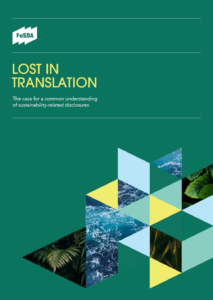
The Future of Sustainable Data Alliance’s new report – ‘Lost in Translation’ – acknowledges the positive evolution of sustainable reporting standards while identifying that interoperability can still be more difficult to address in practice than in principle. The report proposes a number of principles and steps that might enhance harmonisation and interoperability.
The report is designed to inform further stakeholder discussion about how additional progress might best be enabled.
There has been great progress on the standardisation of sustainability-related disclosures in recent years. Mandatory sustainability reporting is now developing at an unprecedented scale. As of July 2026, nearly 40 jurisdictions are adopting, using or aligning their local reporting regime with IFRS Sustainability Disclosure Standards. Similarly, the phasing in of in-scope European companies under the EU’s Corporate Sustainability Reporting Directive, and the forthcoming application to non-EU group parent companies, is increasing the number of companies applying European Sustainability Reporting Standards around the world.
While we have seen the potential these new standards have to improve data availability and quality, we have also seen comparability issues arise as companies apply (or prepare to apply) them. Stakeholders have called for increased focus on interoperability because divergent approaches can require reconciliation across the IFRS Sustainability Disclosure Standards, the European Sustainability Reporting Standards, jurisdictional adaptations and voluntary frameworks such as the GRI Standards, the Taskforce on Nature-related Financial Disclosures (TNFD) and others. Recent cooperation agreements and mappings aim to reduce duplication and improve clarity for companies, investors and other users.
These efforts help, but interoperability seems to be easier to achieve in principle than in practice. As a result, applying multiple disclosure standards can be complicated and costly for companies, and the resulting disclosures can make it difficult for investors and other decision makers to compare companies within sectors and across markets. We see interoperability as necessary to clarify the meaning of sustainable data prepared using different standards so that it can be used effectively for decision making.
FoSDA’s report – ‘Lost in Translation’ – examines interoperability challenges in sustainability disclosure standards, the implications for market participants and the opportunities to enhance the consistency, comparability and utility of sustainability information. The report aims to encourage standard setters, policymakers, companies, investors and data providers to work together to improve sustainable data availability and quality.
The report proposes three principles that might contribute to improved interoperability: a core set of common disclosures; consistent terminology, definitions and methodologies; and the digitalisation of sustainability disclosures.
To take the report forward, over the next few months we will engage stakeholders on three key questions:
- Could harmonisation lead to a set of common disclosures across standards?
- Would a concordance mapping framework support the sustainable data ecosystem?
- Should structured disclosure formats and digital tagging be pursued to help improve machine readability?
Says Magnus Billing, FoSDA Chair: “We welcome standard setters’ commitment to interoperability and the progress being made on implementing sustainability standards. To make the most of these positive developments, it is important that we focus on the detail of making standards work well together. We’re pleased to propose some broad principles for delivering interoperability across different frameworks and to initiate a series of discussions on the key questions that we see as helpful for building on existing work in this area.”
Adds Will Goodhart, FoSDA’s Executive Director: “Interoperability is a vital concept, but is also one that is not always fully or commonly understood. We are pleased to report in detail on what interoperability means, how it works and the remaining challenges to its practical implementation. We are immensely grateful to Hilary Eastman, CFA for her careful stewardship of this project and to the many FoSDA member firms and other stakeholders that supported this work. We now look forward to working with them to identify practical steps to enhancing interoperability to support effective decision making.”
Related News: